

Custom Test Services

We provide custom test services for
1. Static force endurance,
2. Life and fatigue tests,
3. Crash and energy dissipation,
4. Other custom test scenarios
The tests carried out in our company and workshop can be approved by 3rd party laboratories.
The requested tests can be monitored via the focused cameras in your office or on your mobile devices.
Quality Control with Cobots
The abbreviation "cobot"
is derived from the term "collaborative robot." It can detect forces applied to its arms by means of torque sensors or by processing and estimating current signals located on its joints. This allows it to stop without causing harm when human body parts collide with cobot structure. Therefore, under certain conditions, cobots can work safely and in close proximity to humans without the need for safety fences or special sensors.
In the TMEX application,
a cobot is combined with an industrial machine vision camera. According to the scenario, the presence, type information, location, assembly, and strength of the parts comprising the seat are verified at the in-line quality control station.
Cobot products can be used for developing low-power versions of the ingress and egress test demos.
TMEX resumes R&D projects on intelligent tightening processes with cobots and the digitalization of CNC machine feed systems.


Virtual Reality & Twin
Our new original registered trademark METASENSUUM®
is beyond the Metaverse. To unite in perception.. The spinout phase of a new company is progressing to create outstanding impact in industrial design, automotive, aerospace, defense, luxury goods, marketing, real estate, healthcare and service sectors serving not only for the sense of sight but also to all senses.
Our initiative started as demo for Adient Bursa quality laboratory, where all other test stations are developed by TMEX. the digital twin of the designs of the stations are generated during the pre-production stage and evaluated in a virtual space with a 1:1 scale using VR glasses.
The starting reference positions of the virtual space in the VR glasses and the void -under construction- lab space are first matched, then the orientational directions of the headset gets synchronized via the cameras on it. After initial calibration, the customer representative views 360' in the designed laboratory equipped with the test stations in 3D environment while walking in the physically void laboratory. The design viewed by the customer representative in the virtual space is streamed wirelessly to a television outside the laboratory. So the same design perception is shared with the other officials. At the location of the windows in the physical space, a video fed from the VR headset’s cameras is displayed through the windows in the virtual space allowing physical and virtual space matching.
AI Supported Machine Vision
In production lines,
the multiple AI-supported industrial cameras that learn automatically from passing and failing samples, are connected and share analyzed data with the other cameras and production hardware which guarantees 100% traceability of safety components just for an example.


AI-Supported Quality Prediction
Using trends analysis, machine learning, and other AI tools,
especially in fatigue and lifecycle tests that take a long time, a prediction of future putputs with a short portion of the test is calculated. In accordance with these predictions, tests that are projected with high probability to fail are stopped, allowing big time savings for the countermeasures to improve the sample specimen and development processes of the product.
To give an example, for a test that takes 8 months, equally 56 days, within 10% of that period, around 6 days, the sensor data is collected and the model parameters of the dynamical system function for the test specimen is determined using iteration. After that, those parameters are applied to the inputs and the test outputs are compared with the positive criteria. Using this prediction methodology, if the deformation of the specimen at the end of the test is projected to be above a certain level the software interface warns the operator, providing the R&D team an extra period of about 50 days to act early.
3D Prototype
During the pre-production designing stage,
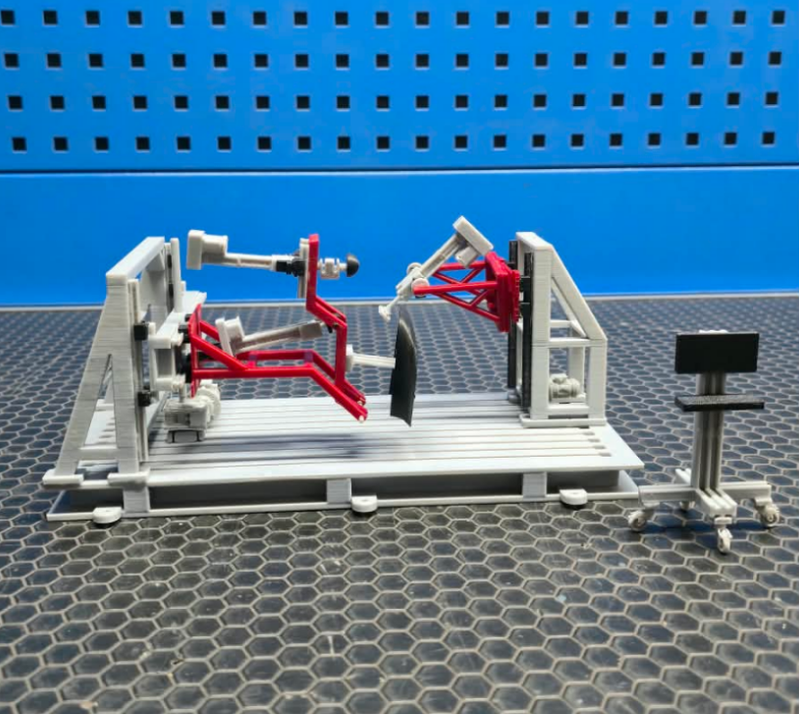
scaled down prototypes are produced using a fast multi-color 3D printer with a large printing table and equipped with digital sensors in TMEX. That allows the evaluation of the design with a tangible object and is gaining popularity, especially in projects intended for mass production avoiding pre-final mold prototypes.
Decision making processes are facilitated this way.

Test Toolends
for UNECE R14, R80, R17, R21
related and other test stations,
we manufacture tool ends.
The dimensional and other physical / chemical properties of the tool ends are reported and validated by Turkish and other institutions approved by the European accreditation agency.
Maintenance
Professional maintenance services are provided upon request for the test stations we manufacture.


Consultancy and Training
For innovation, technological investment and R&D management,
we provide consultancy and training services and certify the participants for the use and maintenance operations for our test stations.
We support our customers from the project selection phase to the application and reporting phases for the European Union and local funding mechanisms.
Software Revision & Modification
We update your current test stations
with our registered LabView / National Instrument, Beckhoff or Panasonic hardware and software.
We undertake the necessary modifications for the mechanical, hydraulic and electrical systems.
We convert the test stations compatible with test related to risk analysis and functional controls as well as the CE norms.
